🍟 Air Fryers
Air fryers have moved well beyond the hype — they genuinely deliver crispy results with significantly less oil than deep frying, and they preheat far faster than a conventional oven. But with basket sizes ranging from 2 liters to 8.5 liters, dual-chamber models, and a flood of accessories, picking the right one takes some thought. This guide walks you through every meaningful decision so you buy exactly what fits your kitchen and cooking habits.




Understanding the Different Types of Air Fryers
The most common format is the basket-style air fryer, where food sits in a perforated drawer that slides in and out. This design circulates hot air efficiently and is easy to clean, making it the default choice for most households. Compact models in the 2–2.5 liter range — like the Arendo 2.5L or the Midea 2L — suit one or two people and take up minimal counter space, but they struggle with family-sized portions.
XXL models (roughly 6–8.5 liters) such as the Russell Hobbs 8.3L or the Chefman TurboFry 8.5L can handle a whole chicken or enough fries for four people in a single batch. The trade-off is a noticeably larger footprint and higher wattage draw. If you cook for a family regularly, the larger capacity usually saves time overall because you avoid multiple rounds.
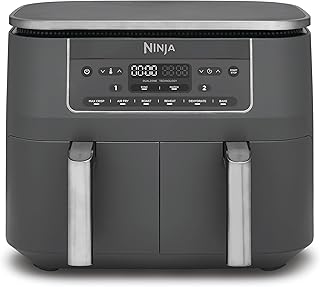
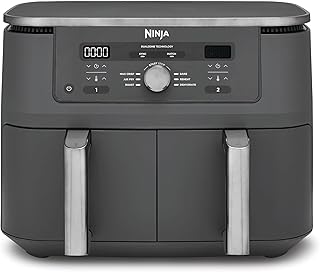
Dual-chamber (double-basket) air fryers are a newer category that splits the cooking space into two independent compartments, each with its own temperature and timer settings. This lets you cook, say, chicken and vegetables simultaneously without flavor transfer or timing conflicts. They tend to be wider rather than taller, so measure your counter space carefully before buying one.
Key Buying Criteria: What Actually Matters
Capacity is the single most decisive factor. A rough rule of thumb: plan for about 1–1.5 liters of basket space per person. A 2L model is honestly only comfortable for one person; a 4–5L handles two to three people well; 6L and above makes sense for families of four or more.
Wattage affects how quickly the air fryer reaches temperature and how evenly it maintains heat during cooking. Most compact models run between 900W and 1200W; larger ones typically need 1500W–1800W. Higher wattage is not a flaw — it usually means faster, more consistent cooking. Check your kitchen's circuit capacity if you plan to run other appliances simultaneously.
Control interfaces range from simple analog dials (reliable, nothing to break) to full digital touchscreens with preset programs. Presets — often labeled for fries, chicken, fish, or baked goods — are convenient but rarely perfect out of the box; expect to adjust time and temperature to your taste. A transparent window or a model that allows you to pull the basket mid-cycle without stopping the program makes it easier to check on food without losing heat.
Common Buying Mistakes to Avoid
Buying too small is the number-one regret. People cooking for two often choose a 2L model to save space, then find themselves running two or three batches for a normal meal, which defeats much of the convenience argument. If space allows, sizing up by one step is rarely something buyers regret.
Ignoring noise and steam output is another oversight. Air fryers are not silent appliances — the fan runs continuously, and some models are noticeably louder than others. Cheaper units can also vent steam aggressively from the back, so placement near cabinetry or walls matters. Check user reviews specifically for noise and ventilation comments.
Overlooking cleaning effort is also common. Baskets with non-stick coatings clean up easily, but the coating quality varies significantly. Look for baskets that are confirmed dishwasher-safe, and check whether the basket and crisper tray are separate pieces — two-piece designs tend to clean more thoroughly than a single solid basket. Avoid using metal utensils or abrasive sponges on any non-stick surface regardless of how durable it looks.
Accessories: What's Useful vs. What's Not
Most air fryers ship with a basic crisper tray or grill rack, which is sufficient for everyday cooking. Beyond that, the accessory market is large but uneven in quality. Genuinely useful additions include silicone baking inserts or small cake pans sized for your basket, a rack that lets you cook on two levels at once, and parchment paper liners pre-cut to fit (these dramatically simplify cleanup when cooking fish or marinated items).
Skewers and rotisserie attachments are only worth considering if your model has a rotating mechanism — most basket-style fryers do not. Spray bottles for a light oil mist are inexpensive and useful regardless of model. Be cautious with third-party accessories: always verify that any insert fits your specific basket dimensions and that the material is rated for the temperatures your air fryer reaches (up to 200°C / 400°F is typical).
Price-Performance Assessment
The air fryer market has matured enough that spending more does not automatically mean better cooking results. In the €40–€60 range — where models like the LEHMANN XL 6.5L, Midea 2L, Russell Hobbs 8.3L, and Chefman 8.5L all sit — you can find genuinely capable machines with decent build quality. At these price points, the main differences are capacity, preset variety, and control panel quality rather than fundamental cooking performance.
Below €35, quality control becomes less predictable: non-stick coatings may degrade faster, fans can be noisier, and temperature accuracy sometimes drifts. Models above €100 often add smart-home connectivity, more precise temperature control, or larger capacity, which is worth it for heavy users but unnecessary for occasional cooking.
For most households, a mid-range model in the 4–6.5L range priced between €40 and €70 will cover the vast majority of use cases without overspending. Prioritize a well-reviewed brand with available customer support and spare basket parts over chasing the lowest price.
Usage and Care Tips for Long-Term Satisfaction
Always preheat the air fryer for two to three minutes before adding food — it makes a measurable difference to browning and texture, especially for frozen items. Avoid overcrowding the basket; air fryers work by circulating hot air around food, and a packed basket blocks that circulation, resulting in uneven cooking and soggy spots. Cook in batches if needed.
A light spray or brush of oil on food (not in the basket itself) helps achieve the crispy surface most people expect from an air fryer. This is especially important for fresh vegetables and lean proteins that have little natural fat. For frozen foods that are already pre-oiled, extra oil is usually unnecessary.
For cleaning, let the basket cool before washing — thermal shock can damage non-stick coatings over time. Wipe the interior of the main unit with a damp cloth after the element cools, and clean the heating coil gently if grease accumulates, as buildup can cause smoke during subsequent uses. With basic care, a quality basket air fryer should last five or more years without significant performance degradation.
Frequently asked questions
- What size air fryer do I need for a family of four?
- Plan for at least 5–6 liters of basket capacity. A 6.5L model like the LEHMANN XL handles family portions comfortably in one batch; 8L+ gives you extra headroom for larger items like a whole chicken.
- Do air fryers really use less electricity than an oven?
- Generally yes, because they preheat in 2–3 minutes versus 10–15 for a conventional oven and cook faster due to concentrated airflow. For small to medium portions, the energy savings are real, though for large roasts a full oven may be more efficient.
- Can I cook raw meat safely in an air fryer?
- Yes. Air fryers reach temperatures sufficient to cook raw chicken, pork, and other meats safely. Use a meat thermometer to verify internal temperatures, just as you would with any cooking method — the air fryer does not change food-safety rules.
- Are the non-stick coatings in air fryer baskets safe?
- Most modern baskets use PTFE (Teflon-type) or ceramic coatings. When used within the manufacturer's temperature limits and not scratched or overheated, these coatings are considered safe. Avoid metal utensils, abrasive scrubbing, and preheating an empty basket at maximum temperature for extended periods to preserve the coating.
Editorial guide, last updated 2026-06-13. Product examples are for orientation; the price shown on Amazon at checkout applies.